

Aquarium Temperature Controllers
A temperature controller is the only device on this site whose entire purpose is to be a second opinion. It exists because the thermostat inside your heater is a single point of failure with a lethal failure mode, and that argument is stronger than any specification we can publish about controllers themselves.
What it does
A controller sits between the wall socket and the heater. It reads water temperature from its own probe and switches power to the heater on and off to hold a setpoint. The heater’s internal thermostat is still there and still trying — the controller simply removes its authority to run indefinitely.
That is the whole value. If the heater’s thermostat sticks closed, the controller cuts power at the ceiling you set. Without one, a stuck thermostat has nothing above it and a tank can reach lethal temperatures within hours.
Redundancy beats specification here. The important question is not which controller has the tightest published accuracy — it is whether there is a second independent device with its own probe between your heater and your livestock at all. A basic controller correctly installed protects a tank far better than a precise heater on its own.
Dual-probe and why it matters
A controller with one probe is protected against heater failure and not against its own. If its probe drifts or falls out of the water, it will hold the wrong temperature confidently — heating to a setpoint measured in air, for instance.
Two-probe designs read redundantly and can alarm on disagreement, which is the failure this class of device is otherwise blind to. Whether a given product does this is not something our data can tell you.
What the numbers can and cannot say
Across 33 products, weight and switched wattage clear both our gates. Switched wattage looks like the useful figure and is not quite: it is a rating of the load the controller can carry, spanning 3 W to 1,800 W across this category, rather than a property of the controller’s own behavior. It tells you whether your heater is within the device’s capacity — a compatibility check — and nothing about how well it holds temperature.
No comparison page for this category. Stated accuracy, probe count, dual-probe redundancy, hysteresis and alarm behavior are the specifications that would decide a purchase and none are published as structured attributes. Publishing quartiles of switched wattage would imply a comparison of controllers when it is really a comparison of the heaters they can drive.
What to confirm
- Switched wattage above your heater’s rating, with margin.
- Probe count and whether the unit alarms on probe failure or disagreement.
- Hysteresis — the band between switch-off and switch-on. Too tight and it cycles constantly; too wide and the tank swings.
- Behavior after a power cut: whether it resumes at its setpoint or reverts to a default.
- Probe placement away from the heater’s own output, or it will read the heater rather than the tank.
No page here promises a livestock outcome. We keep no tank and test nothing. A controller reduces the consequence of one specific failure; it does not remove risk, and it introduces a device of its own that can fail.
Compare them
The finder below is already scoped to this class — 61 of the 458 products in the corpus. Widen or narrow it from there, or open the full aquarium equipment finder to search everything at once. Every result is placed against the median for its own size band, where that band holds at least eight products with a stated figure.
61 products match

Inkbird WiFi ITC-308 Digital Temperature Controller Thermostat | Remote Monitoring Controlling for Home Brewing Fermentation Breeding Incubation Greenhouse
Weight
0.45kg
Temperature Controllers · 200-500 g · 27 products
Weight is +30% against the class median of 0.35.

Digital Temperature Controller Dual Probe Reptile Thermostat Controlled Outlet for Terrarium Heat Mat Heating Pad, Switch Cooling Fan Freezer Fridge ON & Off at Setpoints 10A 1200W
Weight
0.45kg
Temperature Controllers · 200-500 g · 27 products
Weight is +30% against the class median of 0.35.

Inkbird ITC-308 Digital Temperature Controller Outlet Thermostat 2-Stage 1100W with Sensor Reptile Beer Brewing Kegs Fridge Cured Meat Breeding Growing
Weight
0.35kg
Temperature Controllers · 200-500 g · 27 products
Weight is 0% against the class median of 0.35.

BN-LINK Digital Cooling Thermostat Temperature Controller Outlet Switch | Attic Fan Thermostat Control For Exhaust Ventilation Fan, Cooling Devices, Greenhouse, Garage,Brewing,40-108°F 8.3A 1000W ETL
Weight
0.00kg
Temperature Controllers · under 200 g · 10 products
Weight is -100% against the class median of 0.11.

Inkbird All-Purpose Digital Temperature Controller Fahrenheit &Centigrade Thermostat w Sensor 2 Relays (ITC-1000)
Weight
Not stated
This listing does not publish a figure, so it cannot be placed against the baseline.
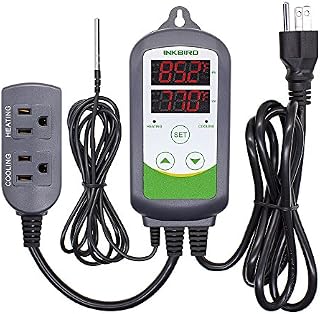
Inkbird ITC-308 Digital Temperature Controller Thermostat | 110V 10A 1100W 2-Stage Outlet with Heating and Cooling Mode for Carboy Homebrew Fermenter Greenhouse Terrarium
Weight
Not stated
This listing does not publish a figure, so it cannot be placed against the baseline.

meross Smart Temperature Controller-Apple HomeKit Support, 15A 1800W | Work with Alexa, Google Home, SmartThing, Easy to Use, for Heating Cooling, HomeBrew, Fermentation, Reptiles, GreenHouse
Weight
0.64kg
Too few products in this class to publish a baseline.

Inkbird ITC-306A WiFi Aquarium Thermostat with Two Probes only for Heater | Heater Controller 120V~1200W Temperature Control for Aquarium Breeding Reptiles Hatching
Weight
0.47kg
Temperature Controllers · 200-500 g · 27 products
Weight is +34% against the class median of 0.35.

WH1436A 10A Temperature Controller 110V | Digital Thermostat Switch Sous Vide Controller NTC 10K Sensor Improved Version
Weight
0.45kg
Temperature Controllers · 200-500 g · 27 products
Weight is +30% against the class median of 0.35.

Inkbird ITC308S Temperature Controller for Aquarium with Submersible Probe, Heating Cooling Outlets Thermostat for Heater and Cooling Fans
Weight
0.45kg
Temperature Controllers · 200-500 g · 27 products
Weight is +28% against the class median of 0.35.

WH2408 Temperature Controller 10A 1200W, Digital Thermostat Controlled Outlet Plug Switch for Reptile Terrarium Greenhouse Homebrew Aquarium Seedling Mat, Heating or Cooling Mode (Pack of 1)
Weight
0.44kg
Temperature Controllers · 200-500 g · 27 products
Weight is +26% against the class median of 0.35.

Inkbird ITC308 Freezer Thermostat Heating Cooling Plug Temperature Controller Outlet 110V 1200W Digital Temp Control for Greenhouse Heater Cooler Reptile Brewing Fermentation Kegerator Probe
Weight
0.41kg
Temperature Controllers · 200-500 g · 27 products
Weight is +17% against the class median of 0.35.
A controller is a second opinion about the heater
A heater has a thermostat; a controller is a separate device that switches the heater's power based on its own probe. That redundancy is the entire point. The failure it protects against is a heater whose contacts have welded closed, which will otherwise heat until something dies, and it is the most common way a tank is lost to equipment rather than to water chemistry. This class exists because the heater's own thermostat has no backup.
Probe placement decides whether any of it works
A controller reads one point in the tank, and if that point is next to the heater it will read high and shut off early, leaving the far end cold. Placing the probe away from the heater and in moving water gives the controller a temperature that represents the tank rather than the equipment. This is the most common installation error in the class and it produces a tank that is consistently a degree or two off with nothing apparently wrong.
Hysteresis, and why a tight band is not better
Controllers switch on and off around a set point with a deliberate gap between the two, because switching at exactly one temperature would cycle the heater constantly. A wider band means fewer switching events and a longer-lived relay; a narrower one holds temperature more tightly and works the hardware harder. Most tanks are entirely happy with a band of a degree, and chasing a tighter one buys stability the livestock cannot perceive at a cost the relay can.
What the alarm is worth
Many controllers here will alarm on an out-of-range temperature, and an alarm nobody hears is decoration. The versions that notify a phone are meaningfully more useful than the ones that beep in an empty room, and both are more useful than a controller that simply switches. For a tank containing anything valuable, the notification is arguably the feature worth paying for rather than the switching itself.
Common questions
Do I need a controller if my heater has a thermostat?
The controller exists because that thermostat can fail closed. Whether you want that protection depends on what the tank is worth to you — but no heater specification addresses the failure.
Is a higher switched wattage better?
No, it is a compatibility ceiling. It needs to exceed your heater’s draw and nothing beyond that is a benefit.
Why is there no comparison page here?
Because accuracy, probe count and hysteresis are unpublished, and the one well-covered number describes the load rather than the controller.
Do you recommend a specific controller?
No. The decision that matters is having one, and that is not a product comparison.