

Aquarium Dosing Pumps
A dosing pump automates the one maintenance task where consistency matters more than attention: replacing what a tank consumes, in small amounts, on a schedule. It is also the piece of equipment on this site with the most direct route from a configuration error to a dead tank.
What a peristaltic pump is doing
Rollers squeeze a flexible tube, pushing liquid along ahead of them. The dosed liquid touches only the inside of that tube, never the pump mechanism, which is why the design suits additives that would corrode or foul a conventional impeller.
Two consequences follow from the mechanism itself. Dose volume is a function of tube bore and roller rotation, so accuracy depends on the tube’s condition — tubing is a consumable, and it deforms with use, which is why calibration is a periodic task rather than a one-off. And because the pump holds the tube closed, it resists back-siphoning, though not well enough to skip a siphon break where one is warranted.
Rate: lower is usually better
Our measured baseline across 59 listings puts dosing rate at 100 ml/min at the 25th percentile, 120 at the median and 275 at the 75th — a wide spread that reflects two different purposes rather than a quality gradient.
For dosing supplements, a lower maximum rate paired with fine control is generally preferable. The pump is being asked to deliver a small volume accurately and repeatably; a high-rate pump asked for a small dose spends its time in the least precise part of its range. Continuous-duty reef dosers cluster at the bottom of the distribution for exactly that reason, while the top belongs to transfer and DIY liquid-handling pumps that happen to be peristaltic.
See the dosing pump spec comparison — dose-rate, voltage and weight quartiles across 59 listings, plus the account of why this category had to be scraped twice.
Channels are the decision the data cannot support
For a reef doser, the number of independent channels is arguably the primary buying decision — a two-part calcium and alkalinity regime needs two, and adding trace elements needs more. Channels must dose separately, and on a two-part system they must not dose simultaneously into the same spot.
Only 19% of listings in this category state a channel count anywhere we can read it, which is below the coverage threshold this site requires, so we publish no figure for it. That is a real gap and we would rather name it than fill it with a plausible default.
This site will not tell you what to dose or how much. Dose rates depend on your tank’s volume, stock and consumption, measured with your own test kit. A generic figure applied to a specific reef is how animals get killed — an alkalinity overdose can take a tank down in hours. We publish what a pump can deliver; what to deliver is yours to determine.
Practical checks the specifications miss
- Calibration method — how you verify actual delivered volume against commanded volume, and how often.
- Tubing replacement interval and cost. A real ownership cost that nothing in this corpus captures.
- Failure behavior after a power cut — whether the schedule resumes, restarts, or silently stops.
- Dose splitting. Many small doses through the day are gentler on parameters than one large one, and not every pump can schedule that way.
- Physical placement above the water line, with the tubing routed so that a failure cannot siphon a container into the tank.
A note on where this category’s data came from
This hub’s corpus was collected twice. The first attempt, searching “Aquarium Dosing Pump”, returned 29 products of which three mentioned dosing at all — the rest were fountain pumps, an RO filter, a glass cleaner and a bottle of fertilizer. The corrected search returns 27 of 27 on topic. The comparison page sets out what the first corpus would have published and why no automated check caught it.
Compare them
The finder below is already scoped to this class — 59 of the 458 products in the corpus. Widen or narrow it from there, or open the full aquarium equipment finder to search everything at once. Every result is placed against the median for its own size band, where that band holds at least eight products with a stated figure.
59 products match

Jecod Jebao Doser 5.4 Bluetooth 4-Channel Auto Dosing Pump | Saltwater Reef Aquarium
Weight
0.91kg
Dosing Pumps · 500 g – 1.5 kg · 9 products
Weight is 0% against the class median of 0.91.

Jecod Jebao Doser 5.6 Bluetooth 6-Channel Auto Dosing Pump | Saltwater Reef Aquarium
Weight
0.91kg
Dosing Pumps · 500 g – 1.5 kg · 9 products
Weight is 0% against the class median of 0.91.

Golander BT100S Basic Variable Speed Peristaltic Pump with Pump Head YT25 (1 Channel), Flow Rate 0.17~720 mL/min Per Channel
Weight
4.99kg
Too few products in this class to publish a baseline.

Jebao Doser 2.4 WIFI 4-Channel Auto Dosing Pump for Saltwater Reef Aquarium
Weight
0.91kg
Dosing Pumps · 500 g – 1.5 kg · 9 products
Weight is 0% against the class median of 0.91.

Jebao WiFi High Precision Dosing Pump Doser MD4.4 Programmable Automatic Marine Aquarium Tank with Pump Holder
Weight
0.91kg
Dosing Pumps · 500 g – 1.5 kg · 9 products
Weight is 0% against the class median of 0.91.

Jebao Programmable Auto Dosing Pump DP-4, Black
Weight
0.91kg
Dosing Pumps · 500 g – 1.5 kg · 9 products
Weight is 0% against the class median of 0.91.

Jebao DP-3 Programmable Auto Dosing Pump, 3 Channel, Black
Weight
0.91kg
Dosing Pumps · 500 g – 1.5 kg · 9 products
Weight is 0% against the class median of 0.91.
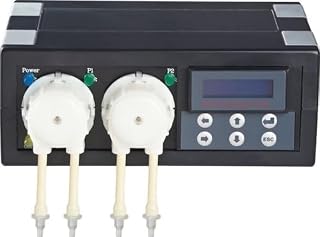
Jecod DP-2 Programmable Auto Dosing Pump, 2 Channel
Weight
0.82kg
Dosing Pumps · 500 g – 1.5 kg · 9 products
Weight is -10% against the class median of 0.91.

Kamoer KCP PRO2 High Flow Peristaltic Dosing Pump, 40-210ml/min Variable Speed 12V DC, Small for Lab Chemical Experiments with Norprene Tube & Power Adapter
Weight
0.76kg
Dosing Pumps · 500 g – 1.5 kg · 9 products
Weight is -17% against the class median of 0.91.

Kamoer KCPA600 24V Peristaltic Pump High Flow Rate Liquid Dosing Pump 180-520ml/min Adjustable, Norprene Tube 4mm ID x 7.2mm OD
Weight
0.49kg
Dosing Pumps · 200-500 g · 15 products
Weight is +69% against the class median of 0.29.

2PCS 12V DC Dosing Pump Peristaltic Dosing Head Low Flow Peristaltic Pump Liquid Small with Connector for Aquarium Lab Analytic Blue
Weight
0.21kg
Dosing Pumps · 200-500 g · 15 products
Weight is -28% against the class median of 0.29.
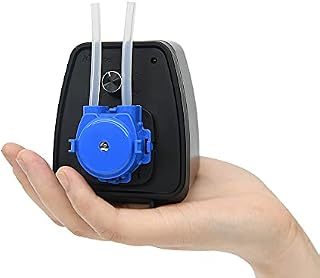
Kamoer KCP-X Mini Peristaltic Pump 24V Low Flow Rate 19-65ml/min | Adjustable Speed for Aquarium Lab Liqiud Dosing Pumpwith Power Adapter Silicone Tube
Weight
0.19kg
Too few products in this class to publish a baseline.
What dosing is actually for
A dosing pump replaces the daily job of adding supplements by hand, and in a reef tank that job is genuinely daily: calcium, alkalinity and magnesium are consumed by growing corals and have to be replaced at a rate that tracks growth. The reason to automate is not laziness but stability — small doses many times a day hold parameters far steadier than one large dose, and stability is what corals respond to more than any absolute value.
Calibration is not optional and drifts
Every pump is rated at a flow that assumes a particular tubing length, height and viscosity, and the rated figure will not match what the pump actually delivers in your setup. Calibrating means running the pump for a set time into a measuring cylinder and adjusting from what arrives. Peristaltic tubing also relaxes with use, so a pump calibrated on installation delivers a little more or less months later. Recalibrating periodically is the difference between dosing and guessing.
Three-part dosing needs separation
Calcium and alkalinity supplements react if they meet in concentrated form, so they are dosed at different times and ideally into different parts of the tank. A multi-channel pump makes that easy and a single-channel one requires planning. Dosing them together into the same spot precipitates the very compounds being added, which wastes the supplement and clouds the water — a common early mistake and an entirely avoidable one.
Fail-safes, because a pump that runs away empties a container
A dosing pump is a device that moves liquid on a schedule, and the failure that matters is one that keeps moving it. A stuck relay or a mis-entered schedule can empty a container of concentrated supplement into a tank overnight, which is not survivable for most livestock. The mitigations are cheap: dose from containers holding no more than a safe quantity, and site the pump above the water line so it cannot siphon if it stops.
Common questions
How many channels do I need?
At least one per additive you dose independently. Our corpus does not publish channel counts often enough to compare, so this is a check to run on the product’s own page.
Is a faster pump better?
For dosing, usually not. Precision at small volumes matters more than speed.
How often does a dosing pump need calibration?
Periodically, because the tubing deforms with use — the manufacturer’s guidance is the authority, and a pump you have never re-calibrated is not delivering what it says.
Do you recommend a specific pump?
No. We publish the category’s distribution and the limits of what it can tell you.