

Wave Makers & Circulation Pumps
Circulation is the one piece of tank equipment that runs continuously and is chosen almost entirely on a number that means nothing on its own. A pump’s flow rating only becomes a decision once you divide it by your tank volume — and that division is what this hub is about.
Turnover, not flow
A pump rated at 3,028 liters per hour — the category median across 60 listings — is roughly 20 turnovers an hour in a 40-gallon tank and about five in a 150-gallon one. The pump has not changed; the answer has.
Turnover is what your inhabitants experience. What they want varies enormously: a planted freshwater tank and an SPS reef are asking for very different things, and neither is asking for whatever the median product happens to supply. Decide the turnover you need from a source that knows your livestock, then use the distribution here to find a pump that delivers it.
See the wave maker spec comparison — flow, power, rated tank and voltage quartiles across 60 listings, with flow-per-watt computed at each.
The always-on cost
Circulation pumps run 24 hours a day, which makes them one of the few genuinely permanent electrical loads on a tank. Our data puts the category median at 8 W producing 3,028 L/h — about 380 liters per hour per watt — with efficiency rising toward the larger end of the category.
Two consequences. The obvious one is running cost. The less obvious one is heat: a pump’s waste energy goes into the water, and on a small tank that is a real contribution to temperature, working against your chiller in summer and alongside your heater in winter.
AC or DC, and why the voltage column tells you which
AC pumps
Run directly from mains at 110–120 V. Simple, generally cheaper, usually one speed. Nothing to fail electronically because there is very little electronics.
DC pumps
Run from a 24 V supply through a controller. That controller is what makes flow programmable — variable speed, pulse and wave modes — and it is also another component that can fail.
In our measured data the voltage figures are two populations rather than one spread: a 25th percentile of 24 V and a median of 110 V. Read that column as a group label rather than a number with a meaningful middle. If programmable flow is why you are buying, the voltage figure is the fastest way to tell which group a pump belongs to.
Placement matters as much as the pump
Flow is directional, and a pump aimed badly produces dead spots and sandstorms at the same time. Two smaller pumps opposing or alternating usually give better distribution than one large one pointed across the tank — and on a reef, alternating flow is closer to what the animals evolved in than a constant jet.
None of that is a specification. It is why the flow number is a starting point rather than an answer.
What the corpus cannot tell you
Flow pattern programmability, controller compatibility, magnet strength and maximum glass thickness are absent from structured data. Noise — one of the most common reasons a pump gets replaced — is not published in any comparable form anywhere in this corpus. And a minority of the 60 listings in this category are not wave makers at all: a sponge filter, a bare nozzle and several general-purpose submersibles came back under the same search.
No page here promises a livestock outcome. We keep no tank and test nothing. Flow that suits one system can stress the inhabitants of another, and this site publishes what pumps state about themselves rather than what your tank needs.
Compare them
The finder below is already scoped to this class — 60 of the 458 products in the corpus. Widen or narrow it from there, or open the full aquarium equipment finder to search everything at once. Every result is placed against the median for its own size band, where that band holds at least eight products with a stated figure.
60 products match

Uniclife Aquarium Wave Maker for 120-300 Gallon Fish Tanks 3400 GPH Adjustable Circulation Pump with Controller and Strong Magnetic Suction Base Submersible Power Head for Fresh and Salty Water
Weight
1.13kg
Wave Makers & Circulation · 500 g – 1.5 kg · 18 products
Weight is +92% against the class median of 0.59.

hygger Mini Wave Maker for 15-40 Gallon Aquarium with Magnetic Mount Quiet Powerhead for Saltwater and Freshwater Fish Tank 530 GPH
Weight
0.41kg
Wave Makers & Circulation · 200-500 g · 18 products
Weight is +15% against the class median of 0.36.

AquaMiracle Aquarium Powerhead Pump Circulating Water Pump 135 GPH for 10-40 Gallon Aquariums with Aerating Features
Weight
0.27kg
Wave Makers & Circulation · 200-500 g · 18 products
Weight is -23% against the class median of 0.36.

hygger 24V DC Water Pump Inline/Submersible Saltwater Aquarium Pump with LCD Display Controller 1350 GPH Return Pump for Coral Reef Tank Sump
Weight
2.63kg
Too few products in this class to publish a baseline.
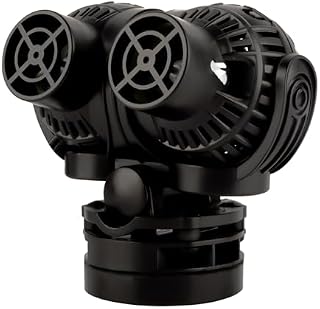
FREESEA Magnetic Wave Maker for Aquarium: 1s Mounts on 15mm Glass Secure | 8W 1600GPH 180°Adjustable Dual Heads Eliminate Dead Spots Improve Water Quality for 55-125 Gallon Fish Tank
Weight
0.59kg
Wave Makers & Circulation · 500 g – 1.5 kg · 18 products
Weight is 0% against the class median of 0.59.

Hydor Koralia Evolution Circulation & Wave Pump , 750-850 GPH, 115 Volts, Black
Weight
0.54kg
Wave Makers & Circulation · 500 g – 1.5 kg · 18 products
Weight is -8% against the class median of 0.59.
Hydor Koralia Evolution Circulation & Wave Pump , 1050-1150 GPH
Weight
0.54kg
Wave Makers & Circulation · 500 g – 1.5 kg · 18 products
Weight is -8% against the class median of 0.59.

hygger 2100GPH Double Head Aquarium Wave Maker, Quiet 5W Aquarium Circulation Pump, with Strong Magnetic Suction Base, 360°Adjustable Power Head, for 40~110 Gal Tank
Weight
0.54kg
Wave Makers & Circulation · 500 g – 1.5 kg · 18 products
Weight is -8% against the class median of 0.59.
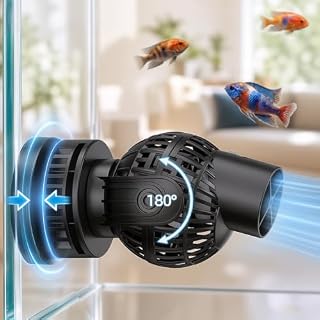
FREESEA Magnetic Wave Maker for Aquarium: 1s Mounts on 15mm Glass Secure | 6W 1050GPH 180°Adjustable Powerful Head Help Eliminate Dead Spots – Improve Water Quality for 40-100 Gallon Fish Tan
Weight
0.40kg
Wave Makers & Circulation · 200-500 g · 18 products
Weight is +13% against the class median of 0.36.

hygger Mini Wave Maker Aquarium Magnetic DC Powerhead with LED Display Controller for Saltwater Tank, 1600 GPH Aquarium Water Circulation Pump 5 to 30 Gallon Black
Weight
0.28kg
Wave Makers & Circulation · 200-500 g · 18 products
Weight is -21% against the class median of 0.36.

hygger Aquarium Wave Maker for 5-10 Gallon Fish Tanks, Adjustable DC Power Heads for Aquarium with Controller, Aquarium Circulation Pump With Magnetic Base for Saltwater Freshwater Tank 660 GPH
Weight
0.18kg
Too few products in this class to publish a baseline.

Uniclife Aquarium Wave Maker for 30-60 Gallon Fish Tanks 1058 GPH Adjustable Circulation Pump with Controller and Strong Magnetic Suction Base Submersible Power Head for Fresh and Salty Water
Weight
Not stated
This listing does not publish a figure, so it cannot be placed against the baseline.
Turnover is the number that matters, and it is not on the box
Flow is stated on most listings here in litres per hour, and the useful figure is that divided by the tank volume: how many times the whole tank passes the pump each hour. Freshwater community tanks are generally content with a handful of turnovers; reef tanks with stony corals want many times more. Buying on raw flow rather than turnover is how a pump sized for a nano ends up in a large tank achieving very little, and how a large pump ends up sandblasting a small one.
Flow is not the same as filtration
A wave maker moves water and does not clean it. Its job is to keep detritus in suspension so the filter can collect it, to prevent dead spots where waste settles and anaerobic pockets form, and in a reef tank to deliver food and carry waste away from corals that cannot move. A tank with strong circulation and inadequate filtration is a tank distributing its problems evenly rather than solving them.
Controllable against fixed speed
A fixed pump runs at one speed continuously, which is simple, cheap and produces a laminar flow that fish work against constantly. A controllable pump can pulse, alternate and ramp down at night, which is closer to what most fish evolved in and noticeably less stressful for them. The gap in price is real and the gap in outcome shows most in tanks with fish that are poor swimmers, where continuous strong flow is exhausting rather than beneficial.
Where the pump physically goes
A wave maker is mounted inside the tank on a magnet or bracket, and the practical constraints are glass thickness and where the cable exits. A magnet rated for thinner glass will not hold on a thick-walled tank, and a pump that falls into the substrate at three in the morning will both stir up the tank and possibly damage itself. Glass thickness is worth measuring rather than assuming, and it is stated on nearly every listing in this class.
Common questions
How much flow does my tank need?
We will not give you a number — it depends on what you keep, and a confident wrong figure blows animals off rock. Decide turnover from a livestock-aware source, then use our distribution to find a pump that provides it.
Is more flow always better?
No. Excess flow in a small tank is a genuine problem rather than a harmless surplus, and the power column shows you pay for it continuously.
AC or DC?
DC if you want programmable flow patterns and accept the controller as another failure point; AC if you want the simplest thing that moves water.
Do you recommend a specific pump?
No. We publish the category’s distribution so you can place a candidate against it.