

Dosing Pump Spec Comparison
The measured baseline for peristaltic dosing pumps across 59 listings — dosing rate, voltage and weight. This category had to be scraped twice, and the reason why is the most useful thing on the page for anyone evaluating spec data they did not collect themselves.
The category baseline
59 listings, of which the following carried usable data.
| Specification | Products with data | Coverage | P25 | Median | P75 |
|---|---|---|---|---|---|
| Dosing rate (ml/min) | 39 | 66% | 100 | 120 | 275 |
| Voltage (V) | 24 | 41% | 12 | 24 | 48 |
| Weight (kg) | 39 | 66% | 0.25 | 0.45 | 0.91 |
Dosing rate is read from titles and feature bullets — “Kamoer KCP PRO2 High Flow Peristaltic Dosing Pump, 210ml/min” — since Amazon carries no structured field for it.
Why this category was scraped twice
The first corpus was not dosing pumps. Searching “Aquarium Dosing Pump” returned 29 products of which three mentioned dosing anywhere in their titles. The rest were submersible fountain pumps, an air pump, a reverse-osmosis filter, a magnetic glass cleaner and a bottle of shrimp fertilizer. Its baseline would have published a median flow of 1,522 liters per hour — a figure describing circulation pumps, in a category where the correct unit is milliliters per minute.
The search term was changed to “Reef Peristaltic Dosing Pump” and the category re-scraped. The replacement corpus was 27 of 27 on topic when first collected, and has since been deepened to 59 listings. Nothing on this page derives from the first attempt.
We record this because it is not visible from the outside. A category page built on the first corpus would have looked exactly like this one — same layout, same confident quartiles — and been describing the wrong products entirely. The check that caught it was reading titles by hand, not any automated coverage or unit test, both of which the bad corpus passed.
Milliliters per minute, not liters per hour
A dosing pump and a circulation pump are both pumps and their specifications are not interchangeable. A doser meters small volumes precisely over time; a circulation pump moves bulk water. Stating a doser’s output in liters per hour is technically possible and practically useless.
Our data carries a flow-in-liters-per-hour figure for part of this category, and we deliberately do not publish it: it is bimodal, because DIY transfer pumps that happen to be peristaltic state liters per hour while reef dosers state milliliters per minute. Pooling them produces a median that describes neither.
A conversion bug worth knowing about. While preparing this page the unit table read “6 milliliters_per_minute” as 6 liters per minute — a thousandfold error — because the key for liters-per-minute matched as a substring inside milliliters-per-minute. A 6 ml/min reef doser was recorded at 360 L/h. It is the same class of mistake as reading milliamp-hours as amp-hours, and it is fixed. Both figures now round-trip correctly.
Reading the dosing rate
The distribution is wide — 100 ml/min at the 25th percentile, 275 at the 75th — and higher is not better. This category contains two purposes.
| Rate | What it suits |
|---|---|
| Around 1–20 ml/min | Continuous-duty reef dosing, where precision over a long period is the whole point |
| 100–130 ml/min | The interquartile middle. General aquarium dosing and top-off duty |
| 275–400 ml/min | Transfer and DIY liquid-handling pumps that happen to be peristaltic. Fast, and not what a reef doser is optimising for |
For dosing supplements, a lower maximum rate paired with fine control is usually preferable to a high one: the pump is being asked to deliver a small volume accurately and repeatably, not quickly. A high-rate pump used for small doses spends most of its time in the least precise part of its range.
The Products These Figures Come From
Of the 59 dosing pumps in this category, 11 publish every figure in the baseline above. All 7 are listed by price tier, then alphabetically — this is not a ranking, and a product appearing here means its listing is complete, nothing more. 3 listings are held back for a published figure far outside the category’s own range — a data defect rather than an unusual product.
| Product | Brand | Price Tier | Dose rate (ml/min) | Voltage (V) | Weight (kg) | Key Details |
|---|---|---|---|---|---|---|
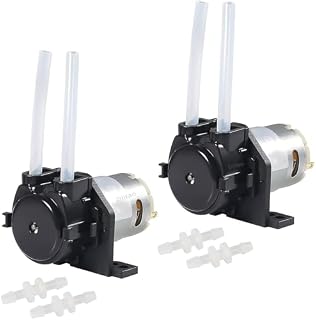 Diitao 2PCS 12V DC Dosing Pump Peristaltic Dosing Head Low… |
Diitao | <$30 | 100.00 | 12 | 0.21 | Plastic · Plastic · DC Powered |
 Diitao 2pcs Peristaltic Dosing Pump 12V DC Low Flow… |
Diitao | <$30 | 100.00 | 12 | 0.32 | Plastic, Stainless Steel · Plastic, Stainless Steel · Battery Powered |
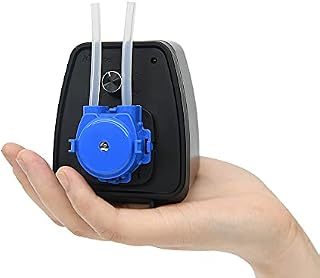 Kamoer KCP-X Mini Peristaltic Pump 24V Low Flow Rate… |
Kamoer | <$30 | 65.00 | 24 | 0.186 | Silicone · Silicone · Ac/dc |
 Kamoer KPHM100-STB10 High-precision Low Flow Peristaltic… |
Kamoer | $30-75 | 180.00 | 24 | 0.24 | Plastic · Plastic · Corded Electric |
 Kamoer M1-KPK200 Small Peristaltic Pump 12V Low Flow… |
Kamoer | $30-75 | 150.00 | 12 | 0.25 | Plastic, Stainless Steel · Plastic, Stainless Steel · Corded Electric |
 Kamoer DIPump-KK300 4 rotors 0-300ml/min high flow… |
Kamoer | $75-200 | 300.00 | 24 | 1.25 | Silicone · Silicone · Corded Electric |
 Kamoer KCP PRO2 High Flow Peristaltic Dosing Pump |
Kamoer | $75-200 | 210.00 | 12 | 0.76 | Stainless Steel · Stainless Steel · wired electric |
Key Details are the listing’s own structured specification rows — material type, material, power source — reproduced as published.
Notes on the Products at the Edges
Most of the products above sit inside the interquartile range on every figure, which is what the baseline already describes. These are the ones it does not: each is outside P25 or P75 on at least one published figure. The position is computed from the category statistics; the explanation is what the listing itself states.
Kamoer DIPump-KK300 4 rotors 0-300ml/min high flow… — Kamoer, $75-200
Weight of 1.25 kg sits above the category P75 of 0.91 kg. A four-rotor bench unit rather than a single-channel doser: the listing states flow to 300ml/min on a 24V supply, a digital readout, and external analog and Modbus control.
Specifications are the manufacturer’s published values as scraped for this corpus, not our own measurements — the same source, and the same limits, as the baseline above. Prices move daily, so we show the tier rather than an amount. Links to Amazon are affiliate links.
What this category does not publish
Channel count appears on only 19% of listings, below our coverage gate, so we do not publish it — which is unfortunate, because for a reef doser the number of independent channels is arguably the primary buying decision. Dosing accuracy, calibration method, tubing material and service life, programmability and app control are all absent from structured data. Tubing is a consumable and its replacement interval is a real ownership cost that nothing here captures.
Nothing above is a recommendation, a ranking or a test result. We do not run a tank. The method, including both gates, is on comparison methodology.
This page will not tell you what to dose or how much. That depends on your tank’s volume, stock and consumption rate, and a generic figure applied to a specific reef is how animals get killed. We publish what a pump can deliver. What to deliver is a decision for you and your test kit.
Common questions
Is a higher ml/min rating better?
For dosing supplements, usually not. Precision at small volumes matters more than speed, and a high-rate pump asked for a small dose is working at the least accurate end of its range.
Why don’t you publish channel count?
Only 19% of listings state one, which is below the coverage threshold this site requires. It is the field to revisit if the category is ever scraped more deeply, and it is noted as such in the site config.
Can I use a DIY peristaltic pump for reef dosing?
Mechanically they are the same principle, and the differences that matter — continuous-duty rating, calibration, programmability — are exactly the ones this corpus does not publish. That is a question for the product’s own documentation.
Do you rank dosing pumps?
No. This page publishes a distribution, plus an account of how the category’s first corpus was wrong.