
Aquarium Water Quality Monitors
This category mixes two things that share a shelf and almost nothing else: continuous electronic monitors with probes in the water, and disposable chemical tests you read by eye. They answer different questions on different timescales, and no single table can compare them.
Two different instruments
Continuous monitors
A probe stays in the tank and reports constantly — usually pH, temperature, sometimes salinity or ORP. They catch a trend, and a trend is what you want for a parameter that drifts. They need calibration against reference solutions, and a probe that has drifted reports confidently and wrongly.
Test kits and strips
Chemical reagents read against a color chart, or a digital tester used on a sample. They catch the parameters that matter most for livestock — ammonia, nitrite, nitrate — which almost no continuous monitor measures. They are point-in-time and depend on your reading of a color.
The important asymmetry: the parameters that kill fish fastest are the ones continuous monitors do not track. Ammonia and nitrite are chemistry-kit territory. A tank with a beautiful continuous pH log can still be in an ammonia spike.
What our data can tell you: very little
Across 30 products, weight alone clears both our gates. Measured parameters, probe count, stated accuracy, calibration requirements and probe service life — every specification that would let you compare these products — are absent from Amazon’s structured data.
There is no comparison page for this category, and it is the clearest case on the site where publishing a table would be worse than publishing none.
The category also has a relevance problem worth naming: the search returns hydroponics equipment alongside aquarium equipment, because a pH meter does not care what the water is for. That is fine for a meter and misleading for anything sold as tank-specific.
What to check instead
- Which parameters a device actually measures, and whether they include the ones that matter for your stock.
- Calibration: what solutions it needs, how often, and whether they are included. An uncalibrated probe is not a measurement.
- Probe service life and replacement cost. Probes are consumables and this is the real cost of ownership.
- Freshwater or reef. Salinity and ORP matter for one and not the other, and range specifications differ.
- Whether it alarms or only logs. A monitor you have to look at is a record, not a warning.
We will not tell you your target parameters. They depend on what you keep, and a generic figure applied to a specific tank is how animals get harmed. This site publishes what equipment states about itself; what your water should read is a question for a livestock-aware source and your own test kit.
Compare them
The finder below is already scoped to this class — 60 of the 458 products in the corpus. Widen or narrow it from there, or open the full aquarium equipment finder to search everything at once. Every result is placed against the median for its own size band, where that band holds at least eight products with a stated figure.
60 products match
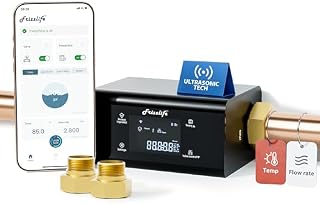
Frizzlife LP365 Smart Water Monitor and Automatic Shutoff Valve – 0.01GPM Ultrasonic Micro Leak Detection, APP Wi-Fi Remote Control, Real-Time Flow/Temp Alarm, 24/7 Water Usage Reports, 3/4" and 1"
Weight
1.77kg
Too few products in this class to publish a baseline.

HoneForest TDS Meter, Digital Water Tester – Accurate and Reliable, Measures TDS, EC & Temperature (°F/°C), 0-9990ppm, Water Test Meter for Drinking Water, RO/DI System, Aquariums, etc
Weight
0.05kg
Water Quality Monitors · under 200 g · 24 products
Weight is -13% against the class median of 0.05.

PAIZOO Aquarium Thermometer Digital, Highly Accurate Fish Tank Thermometer | LED Display, 8000h Battery Life, Precise Temp Gauge, Range 0-140℉, Stick-on Fish Tank Thermometer for Betta, Axolotl & Turtle
Weight
0.02kg
Water Quality Monitors · under 200 g · 24 products
Weight is -66% against the class median of 0.05.

hygger 60W Smart Aquarium LED Light with Water Monitor for 48-55 Inch Tanks | Auto Lift-Up TFT LCD Screen, Temperature Monitor, Water Quality Monitoring, Full Spectrum Lighting, Intelligent Control
Weight
Not stated
This listing does not publish a figure, so it cannot be placed against the baseline.

Water Quality Tester pH/EC/TDS/Salinity/SG/Temperature with Easy Calibration 24Hrs Online APP Monitoring for Fish Tank Aquariums Home Laboratory Smart Instrument
Weight
0.94kg
Water Quality Monitors · 500 g – 1.5 kg · 9 products
Weight is +38% against the class median of 0.68.

kactoily Smart Aquarium Water Monitor, Salinity pH ORP TDS EC Temp Multi-Parameter Tester for Freshwater Saltwater Fish Tanks Real-Time Alerts Upgraded Version
Weight
0.61kg
Water Quality Monitors · 500 g – 1.5 kg · 9 products
Weight is -11% against the class median of 0.68.

7-in-1 Water Quality Monitor, Dual Mode Local Display & WiFi Smart Monitoring, pH ORP TDS EC Salinity S.G. Temp Meter for Aquariums, Reef Tanks, Hydroponics & Ponds
Weight
0.55kg
Water Quality Monitors · 500 g – 1.5 kg · 9 products
Weight is -19% against the class median of 0.68.

Apera Instruments AI311 Premium Series PH60 Waterproof pH Pocket Tester Kit, Replaceable Probe, ±0.01 pH Accuracy, Lcd display
Weight
0.28kg
Water Quality Monitors · 200-500 g · 8 products
Weight is -21% against the class median of 0.36.

2025 All-New 4 in 1 Tds Meter Digital Water Tester – Accurate and Reliable TDS EC & Temp(°C,°F) Meter – 0-9999ppm – Professional Testing for Drinking Water, RO/DI System, Aquariums etc
Weight
0.10kg
Water Quality Monitors · under 200 g · 24 products
Weight is +89% against the class median of 0.05.

7 in 1 Smart Water Quality Tester, Wireless WiFi Water Monitor Measures pH/ORP/TDS/EC/Salinity/SG/TEMP, Water Quality Meter with App Connection Real-Time Alerts for Aquarium, Saltwater Fish Tank, etc.
Weight
0.09kg
Water Quality Monitors · under 200 g · 24 products
Weight is +72% against the class median of 0.05.
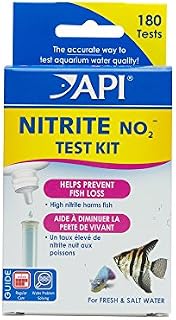
API NITRITE TEST KIT 180-Test Freshwater and Saltwater Aquarium Test Kit
Weight
0.07kg
Water Quality Monitors · under 200 g · 24 products
Weight is +28% against the class median of 0.05.
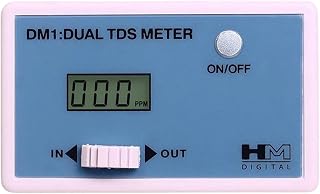
HM Digital DM-1 In-Line Dual TDS Monitor, 0-9990 ppm Range, +/- 2% Readout Accuracy,Blue & White
Weight
0.05kg
Water Quality Monitors · under 200 g · 24 products
Weight is -15% against the class median of 0.05.
Almost nothing here is comparable on specifications
Two listings in this category state a power figure and one states a tank rating; the rest publish no numeric specification that can be compared at all. These are probes and controllers sold on what they measure rather than on how they are built, so this page compares what is available and says plainly where nothing is. The figures that would matter — accuracy, drift rate, probe life — are not published by anyone here.
Probes are consumables, not hardware
A pH probe has a glass membrane that ages whether or not it is used, and a working life measured in one to two years. It drifts continuously through that life, slowly enough to be invisible and fast enough to matter. A monitor with an old probe reports a confident number that is wrong, which is worse than no monitor at all because it is trusted. The recurring cost of replacement probes is a real part of owning one and appears on no listing.
Calibration is the whole accuracy story
A pH probe is calibrated against buffer solutions of known value, and a monitor is only as accurate as its last calibration. Monthly is a common recommendation and quarterly is what most people manage. TDS and conductivity meters drift less and still need checking. The pattern across this class is that the device is cheap, the consumables and the discipline are not, and the discipline is what decides whether the readings mean anything.
What a number does not tell you
A stable slightly-wrong pH is generally less harmful than a correct pH that swings, and the monitors here report the value rather than the trend. What matters to livestock is stability, so the useful reading is the shape over a week rather than the digit at a moment. A monitor logging to an app earns its place here in a way a bare display does not, because the trend is the information and the instantaneous value mostly is not.
What to measure, and in what order
A tank with a problem is usually telling you through ammonia, nitrite or nitrate rather than through pH, and those are measured with test kits rather than with the probes in this class. The continuous monitors here earn their place for parameters that drift and matter continuously — temperature, pH in a reef, salinity — rather than for the ones checked weekly. Buying a monitor before a test kit is a common inversion and an expensive one.
Common questions
Can a continuous monitor replace my test kit?
Not for ammonia and nitrite, which most continuous monitors do not measure and which are the parameters that harm fish fastest. They complement each other.
Why is there no comparison page here?
Because only weight cleared our gates across 30 products, and weight is not a reason to choose a monitor.
Are test strips accurate enough?
They are quicker and coarser than liquid reagent kits. Which is enough depends on how tight your requirement is — a question about your tank rather than about the product.
Do you recommend a specific monitor?
No. Check which parameters a device measures against the ones you actually need.