

Wave Maker & Circulation Pump Spec Comparison
The best-documented category on this site. Flow rate, power draw, rated tank volume and voltage across 60 listings — enough coverage to compute flow per watt across the whole category, which is the one efficiency figure that separates otherwise identical-looking pumps.
The category baseline
60 listings, of which the following carried usable data.
| Specification | Products with data | Coverage | P25 | Median | P75 |
|---|---|---|---|---|---|
| Flow rate (L/h) | 51 | 85% | 1,708 | 3,028 | 5,838 |
| Power draw (W) | 43 | 72% | 5 | 8 | 13 |
| Weight (kg) | 43 | 72% | 0.32 | 0.54 | 0.64 |
| Voltage (V) | 32 | 53% | 24 | 110 | 120 |
| Rated tank volume (US gal) | 34 | 57% | 40 | 60 | 100 |
Flow is stated in gallons per hour on most listings and in liters per hour on the rest; everything above is normalized to liters per hour. The median 3,028 L/h is about 800 GPH.
Flow per watt
Dividing the medians gives roughly 380 liters per hour per watt — 3,028 L/h from 8 W. At the quartiles it is 342 L/h per watt at P25 and 449 at P75, so efficiency rises toward the larger end of the category rather than peaking in the middle.
| Position | Flow | Power | L/h per watt |
|---|---|---|---|
| P25 | 1,708 L/h | 5 W | 342 |
| Median | 3,028 L/h | 8 W | 380 |
| P75 | 5,838 L/h | 13 W | 449 |
This matters more than it looks. A circulation pump runs continuously, so its draw is one of the few genuinely always-on loads on a tank, and the difference between 342 and 449 L/h per watt is a permanent difference in running cost and in heat added to the water. On a small tank, pump waste heat is not negligible.
As with every ratio on this site, these are quartiles of two separate distributions rather than an average of per-product ratios. Read them as where the category sits.
The voltage column is two populations
The voltage figures do not describe one kind of product. A median of 110 V with a 25th percentile of 24 V is not a spread — it is two groups: AC pumps running directly from mains, and DC pumps running from a 24 V supply with a controller between them.
The DC group is the one that takes flow programming, since a controllable pump needs electronics that a mains AC pump does not have. If adjustable flow patterns are the reason you are buying, the voltage column is the fastest way to tell which group a pump belongs to — but read it as a category label rather than as a number with a meaningful median.
How to place a pump against this
| Where it falls | What that means |
|---|---|
| Under 1,708 L/h | Below P25. Nano tanks and supplementary flow in a corner a return pump does not reach |
| 1,708–3,028 L/h | Lower half. The common range for tanks up to roughly 40 gallons |
| 3,028–5,838 L/h | Upper half. Rated tank volumes cluster at 60–100 gallons here |
| Over 5,838 L/h | Above P75. Check the power column too — the efficiency advantage of the middle of the category disappears at this end |
Turnover, not flow, is the number you are actually choosing. A pump’s rating is meaningless without your tank volume beside it: 3,028 L/h in a 40-gallon tank is roughly 20 turnovers an hour, and the same pump in a 150-gallon tank is about five. What each inhabitant wants varies enormously — a planted tank and an SPS reef are not asking for the same thing, and neither is asking for what the median product supplies. Divide, then decide.
The Products These Figures Come From
Of the 60 wave makers in this category, 12 publish every figure in the baseline above. All 9 are listed by price tier, then alphabetically — this is not a ranking, and a product appearing here means its listing is complete, nothing more. 1 listing is held back for a published figure far outside the category’s own range — a data defect rather than an unusual product.
| Product | Brand | Price Tier | Flow (L/h) | Power (W) | Weight (kg) | Voltage (V) | Rated tank (US gal) | Key Details |
|---|---|---|---|---|---|---|---|---|
 AquaMiracle Aquarium Powerhead Pump Circulating Water Pump… |
AquaMiracle | <$30 | 511 | 4.8 | 0.27 | 120 | 40 | Epoxy-sealed submersible motor; ships with air tubing and a venturi for aeration |
 FREESEA Magnetic Wave Maker for Aquarium |
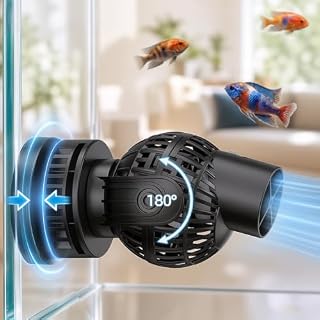
FREESEA | <$30 | 3,975 | 6 | 0.40 | 110 | 100 | Magnetic mount for glass up to 15 mm; dual heads adjustable through 180° |
 hygger 2100GPH Double Head Aquarium Wave Maker |
hygger | <$30 | 7,949 | 5 | 0.54 | 240 | 110 | Twin outputs on a 360° rotating base; both a suction-cup and a magnet base supplied |
 hygger Mini Wave Maker for 15-40 Gallon Aquarium with… |
hygger | <$30 | 2,006 | 3 | 0.41 | 120 | 40 | Magnet mounts on 4-10 mm glass; 360° ball joint; ceramic shaft, ETL certified |
 Marine Color SunSun JVP-110 2.5W 528GPH Mini Wavemaker with… |
Marine Color | <$30 | 1,999 | 2.5 | 0.204 | 220 | 60 | Suction-cup mount aimed manually through 360°; oil-free motor; 4.5 ft cord |
 Hydor Koralia Evolution Circulation & Wave Pump |
Hydor | $30-75 | 3,217 | 5 | 0.54 | 115 | 100 | Shaft-less impeller; vibration-absorbing magnet and suction support for glass to 1/2 inch |
 hygger Adjustable Flow Aquarium Wave Maker 24V DC Quiet… |
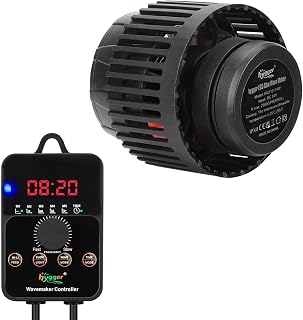
hygger | $30-75 | 690 | 8 | 0.59 | 24 | 100 | External controller, 5 flow modes and scheduling; 24 V DC brushless motor; magnetic holder |
 hygger Aquarium Wave Maker for 5-10 Gallon Fish Tanks |
hygger | $30-75 | 2,500 | 9 | 0.18 | 12 | 10 | Three interchangeable outlets, 3 wave modes and 6 flow rates; 10-minute feeding pause |
 hygger Mini Wave Maker Aquarium Magnetic DC Powerhead with… |
hygger | $30-75 | 6,057 | 14 | 0.28 | 12 | 30 | LED controller sets mode, strength and frequency; 12 V DC; magnet base; feeding pause |
Key Details summarize what each listing states about itself, in our words rather than the seller’s. Every claim is checked against the listing text it was taken from.
Notes on the Products at the Edges
Most of the products above sit inside the interquartile range on every figure, which is what the baseline already describes. These are the ones it does not: each is outside P25 or P75 on at least one published figure. The position is computed from the category statistics; the explanation is what the listing itself states.
hygger 2100GPH Double Head Aquarium Wave Maker — hygger, <$30
Voltage of 240 V sits above the category P75 of 120 V. This is the mains-rated population the voltage section describes rather than a low-voltage DC pump; the listing supplies both a suction-cup and a magnet base.
Marine Color SunSun JVP-110 2.5W 528GPH Mini Wavemaker with… — Marine Color, <$30
Voltage of 220 V sits above the category P75 of 120 V. Also a mains-rated listing rather than a DC pump, recommended for 30 to 60 gallon tanks and aimed manually through 360 degrees.
hygger Aquarium Wave Maker for 5-10 Gallon Fish Tanks — hygger, $30-75
Weight of 0.18 kg sits below the category P25 of 0.32 kg. Sized for 5 to 10 gallon tanks, the smallest bracket here, with three interchangeable outlets and 6 adjustable flow rates.
Specifications are the manufacturer’s published values as scraped for this corpus, not our own measurements — the same source, and the same limits, as the baseline above. Prices move daily, so we show the tier rather than an amount. Links to Amazon are affiliate links.
What this category does not publish
Flow pattern programmability, controller compatibility, magnet strength and the maximum glass thickness a mount will hold are all absent from structured data. Noise, which is one of the most common reasons a pump gets replaced, is not published in any comparable form anywhere in this corpus. Several of the 60 listings in the category are not wave makers at all — a sponge filter, a bare nozzle, and several general-purpose submersible pumps — so read a specific product’s own page rather than assuming category membership means much.
Nothing above is a recommendation, a ranking or a test result. We do not run a tank. The method, including both gates, is on comparison methodology.
Common questions
How much flow does my tank need?
We will not give you a number, because it depends on what you keep and a wrong figure applied confidently is how animals get stressed or blown off rock. What this page gives you is the category’s distribution, so you can see where a candidate sits once you have decided on a turnover rate from a source that knows your livestock.
Is a higher flow rating always better?
No. Excess flow in a small tank is a real problem, not a harmless surplus, and the power column shows you pay for it continuously. Turnover relative to your volume is the figure that matters.
Why is the voltage median 110 V when so many pumps are 24 V?
Because the category contains both AC and DC pumps and the median falls in the AC group. The number is a group label rather than a meaningful central value — that is why it is described that way above rather than presented as a typical voltage.
Do you rank these pumps?
No. This page publishes a distribution so you can place a product against its category.