

Aquarium Heaters
A heater is the only piece of equipment on a typical tank that can kill everything in it within hours by working too well. That asymmetry — gentle failure in one direction, catastrophic in the other — should shape how you buy one, and it is not something a wattage rating tells you.
Sizing: what watts actually buy
A heater’s wattage is a rate of heat delivery. What your tank needs depends on the temperature lift — the gap between the coldest your room gets and the temperature you are holding — not on volume alone. A 40-gallon tank in a heated living room and the same tank in an unheated garage are different problems.
The rule most often quoted is 3 to 5 watts per gallon, lower for a warm room and higher for a cold one. Our measured data across 60 listings puts the category at a median of 100 W rated for 30 gallons — 3.3 watts per gallon, inside that range. At the small-tank end it sits at the top of it: a 50 W heater rated for 10 gallons is 5 W/gal, because small tanks lose heat faster relative to their volume.
Size from your own worst case: the coldest night, not the average day.
See the aquarium heater spec comparison — wattage and rated-volume quartiles across 60 listings, with watts-per-gallon computed at each and the fields we removed.
The failure that matters
Heaters fail in two directions. A heater that fails off lets a tank drift down slowly — usually survivable, often noticed. A heater whose thermostat sticks closed keeps heating, and a tank can reach lethal temperatures within hours.
No specification in this category predicts which way a given unit fails. What protects a tank is not a better number but a second independent device: a separate temperature controller with its own probe, cutting power at a set ceiling, so the heater’s own thermostat is not the only thing between your livestock and a runaway.
The same reasoning argues for two smaller heaters rather than one large one. A single stuck-closed unit then has less authority over the water, and a single failed-off unit does not leave the tank unheated. It costs a second device and a second cord, and it is the cheapest redundancy available on a tank.
What the corpus cannot tell you
Temperature accuracy, thermostat type, whether the body is shatterproof and whether there is an over-temperature cutout are all absent from Amazon’s structured data and mostly from the bullets too. Those are precisely the properties that decide behavior when something goes wrong — so this site can publish the category’s power distribution and cannot rank its reliability. We would rather say that than imply otherwise.
Both figures we do publish — wattage at 93% coverage and rated tank volume at 77% — were read out of product titles rather than structured fields, because Amazon carries neither for this category.
Practical checks
- Match the heater to the lift, not just the gallons. Cold room, more watts.
- Consider two units instead of one on anything above roughly 40 gallons.
- Add an independent controller if the livestock is valuable or the room is unstable. This matters more than the choice of heater.
- Check placement requirements — most heaters need flow past them to read the water accurately, and a heater in a dead corner will cycle badly.
- Use a separate thermometer that is not the heater’s own dial, so you can tell when the dial is lying.
No page here promises a livestock outcome. We keep no tank and test nothing. A specification describes what a device is built to do, not what it does when a probe drifts or a relay welds shut.
Compare them
The finder below is already scoped to this class — 38 of the 458 products in the corpus. Widen or narrow it from there, or open the full aquarium equipment finder to search everything at once. Every result is placed against the median for its own size band, where that band holds at least eight products with a stated figure.
38 products match

Fluval E 100 Watt Electronic Heater
Weight
0.43kg
Heaters · 200-500 g · 12 products
Weight is +48% against the class median of 0.29.

SunGrow Water Heater, 10W, Turtle Aquarum Tank, Cat & Dog Heated Bowl, Warm Water Encourage Drinking, Bird Fountain Deicer, Chicken & Horse Water Dispenser Warmer, Quail Waterer Storage Bucket
Weight
0.14kg
Heaters · under 200 g · 11 products
Weight is -12% against the class median of 0.16.
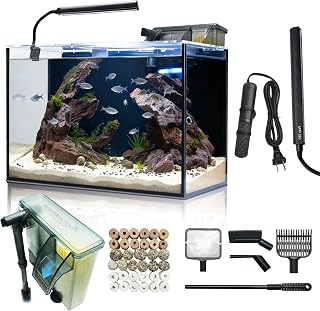
10 Gallon Aquarium Set Glass Fish Tank, Heater Self Cleaning System Filter with Media Bright Light Cleaning Tool, Leak-Proof Clear Rimless Betta Tropical Freshwater Fish
Weight
9.91kg
Too few products in this class to publish a baseline.

HiTauing Aquarium Heater, Upgraded 300W/500W Fish Tank Heater with Intelligent Leaving Water Automatically Stop Heating and Advanced Temperature Control System, Suitable for Saltwater and Freshwater
Weight
0.64kg
Too few products in this class to publish a baseline.

200W Aquarium Heater for 20-40 Gallon with Auto Shut-Off When Leaving Water—Submersible Fish Tank Heater, Dry-Burn & Overheat Protection, Explosion-Proof, Freshwater Saltwater Turtle Tank
Weight
0.57kg
Too few products in this class to publish a baseline.

MQ Titanium Alloy 500W Aquarium Heater for Salt and Fresh Water, Digital LED Display Submersible Heater with External Thermostat Controller, for Fish Tank 70-80 Gallon
Weight
0.39kg
Heaters · 200-500 g · 12 products
Weight is +33% against the class median of 0.29.

Marineland Precision Heater for Saltwater or Freshwater Aquariums | For saltwater or freshwater tanks
Weight
0.33kg
Heaters · 200-500 g · 12 products
Weight is +14% against the class median of 0.29.

Aqueon Submersible Aquarium Heater, 300 Watts, Up to 100 Gallons | 300 watt aquarium heater for freshwater and saltwater tanks, adjustable 68-88°F with auto shut-off
Weight
0.30kg
Heaters · 200-500 g · 12 products
Weight is +1% against the class median of 0.29.

Aqueon Aquarium Fish Tank Heater, Preset, Up to 75 Gallons, 200 Watts | 75 gallon aquarium heater, fully submersible with auto shut-off, preset 78° and shatter-resistant quartz glass
Weight
0.27kg
Heaters · 200-500 g · 12 products
Weight is -7% against the class median of 0.29.

Aqueon Small Aquarium Heater, 7.5W, Up to 3 Gallon Aquariums | Submersible small fish tank heater for desktop aquarium, mounts vertically or horizontally with suction cups
Weight
0.18kg
Heaters · under 200 g · 11 products
Weight is +14% against the class median of 0.16.

YukiHalu USB Powered Aquarium Heater, 10W Adjustable Mini Fish Tank Heater with External Temperature Controller, LED Display, Used for 0.5-1 Gallon Tank (10W USB)
Weight
0.12kg
Heaters · under 200 g · 11 products
Weight is -25% against the class median of 0.16.

Fluval P25 Submersible Aquarium Heater
Weight
0.09kg
Heaters · under 200 g · 11 products
Weight is -43% against the class median of 0.16.
Sizing by watts per gallon, and why the rule is soft
The common rule is three to five watts per gallon, and it is a starting point rather than an answer. What it leaves out is the gap between room temperature and tank temperature, which is the work the heater actually does: a tank in a heated living room needs far less than the same tank in an unheated conservatory, and the rule assumes the former. This is the best-specified class on the site — nearly every listing states a wattage and most state a tank rating — so the comparison is available here in a way it is not elsewhere.
Two smaller heaters beat one large one
A single heater has two failure modes and both are bad: it fails off and the tank cools, or it sticks on and the tank cooks. Splitting the wattage across two units halves the consequence of either. Two heaters that each fail off leave the tank at half power rather than none, and a stuck-on heater at half the wattage raises the temperature more slowly and to a lower ceiling, which buys hours to notice. The cost is marginal and it is the single most effective thing an aquarium owner can do about heater failure.
The built-in thermostat is not a controller
Every heater has a thermostat and it is a bimetallic strip set at the factory, typically accurate to a degree or two and prone to drifting as it ages. That is adequate for hardy freshwater fish and inadequate for anything sensitive, which is why an external controller exists as a separate product. A heater's own thermostat is a primary control with no backup; the failure it cannot protect against is its own contacts welding shut.
Glass, titanium and where each belongs
Glass heaters are cheap, widely available and break — usually when a substrate is disturbed or a large fish is boisterous, and occasionally when one is left running as the water drains during a change. Titanium and shatterproof-coated units cost more and survive both. In a tank with large cichlids, turtles or a strong-armed owner the extra cost is insurance rather than luxury, and it is the specification most listings describe in marketing terms rather than as a material.
Common questions
How many watts do I need for my tank?
It depends on your temperature lift, which depends on your room. The 3–5 W/gallon rule is a starting point; our category median sits at 2.5 W per rated gallon, which tells you how manufacturers rate their products rather than how much heat your room demands.
Is one big heater or two small ones better?
Two splits the risk in both failure directions at the cost of a second device. It is a judgement about consequences rather than a specification question.
Do I need a separate temperature controller?
If a stuck-closed heater would be a serious loss, yes — it is the only thing that addresses that failure mode. No heater spec does.
Do you recommend a specific heater?
No. We publish the category’s distribution so you can place a candidate against it.