

Automatic Fish Feeders
A feeder is bought for a holiday and then usually kept, and the two use cases have opposite requirements. For a week away you want a device that cannot possibly dump its whole hopper. For daily use you want portion consistency over months. Very little in the specifications addresses either.
The failure mode is overfeeding, not underfeeding
Fish tolerate a surprising amount of not being fed. A healthy adult community tank comes through a week without food far better than most owners expect.
What it does not come through is a hopper emptying itself. Uneaten food decays, ammonia climbs, and the tank crashes while nobody is there — which is precisely when a feeder is running unattended. The asymmetry is severe enough that “feeds less than I set” is a nuisance and “feeds more than I set” is a disaster.
Test the feeder over several days before you rely on it, with the tank in front of you and the food you actually use. It is the only meaningful check available, because nothing in the published specifications predicts jamming or humidity clumping.
What the numbers can say
Across 30 products, weight (63%) and chamber capacity (53%) clear both our gates. The chamber-capacity median sits at 0.2 liters, which describes the hopper and tells you how long it can run — not how accurately it doses.
Capacity is also the most overloaded label in our whole corpus. On this category alone it has meant a chamber volume in centilitres, the tank size in gallons on a slow-release block, a food mass in grams, and a bare “Count”. One listing recorded 200 centilitres and was read as 200 liters until the conversion table was corrected. We publish the figure with that history known, and no comparison page — two fields, one of them fragile, is not a comparison.
What actually separates these products
- Food type compatibility. Flake, pellet and granule behave completely differently in a dispenser. Flake bridges and clumps; pellets flow. A feeder that handles one may jam on another.
- Humidity protection. A tank is a humid environment and damp food clumps. Some feeders use a desiccant compartment or a fan; whether one does is rarely published.
- Portion adjustability and repeatability — how finely you can set a dose, and whether dose ten matches dose one.
- Feeds per day and whether multiple small feeds are possible, which suits most fish better than one large one.
- Battery backup. A mains-powered feeder that loses its schedule in a power cut has failed at the one moment it mattered.
No page here promises a livestock outcome. We keep no tank and test nothing. A feeder is a mechanism running unsupervised next to animals that cannot leave.
Compare them
The finder below is already scoped to this class — 60 of the 458 products in the corpus. Widen or narrow it from there, or open the full aquarium equipment finder to search everything at once. Every result is placed against the median for its own size band, where that band holds at least eight products with a stated figure.
60 products match
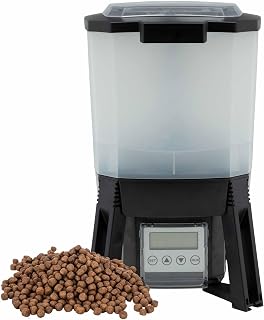
The Pond Guy KoiGrower Automatic Pond Fish Food Dispenser, 5 Gallon | Uses Solar, Battery & AC Electric Power with Auto Timed Koi Pellet Feeder operation
Weight
3.29kg
Too few products in this class to publish a baseline.
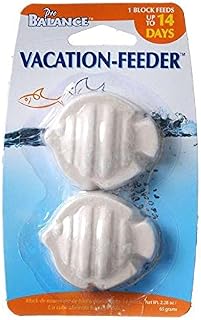
Penn Plax Fish Shape Vacation Fish Feeder, 2.2 oz.
Weight
0.05kg
Too few products in this class to publish a baseline.

hygger Large Programmable Auto Pond Feeder with LCD Display Controller Automatic Fish Food Feeding Dispenser Outdoor Koi Fish Feeder 5.5 L Capacity
Weight
2.27kg
Too few products in this class to publish a baseline.

Fish Mate P21 Programmable Automatic Fish Feeder for Pond & Large Aquariums
Weight
0.60kg
Too few products in this class to publish a baseline.

hygger WiFi Automatic Fish Feeder for Aquarium, Smart App Control Auto Fish Food Dispenser with Camera and Timer, Vacation Feeder with 230ml Large Capacity and USB Cable for Turtle Betta Koi Tank
Weight
0.50kg
Automatic Feeders · 200-500 g · 19 products
Weight is +72% against the class median of 0.29.

EHEIM TWIN Automatic Feeder, Battery Operation, Random
Weight
0.32kg
Automatic Feeders · 200-500 g · 19 products
Weight is +10% against the class median of 0.29.

DXOPHIEX WiFi Fish Feeder Automatic Fish Feeder Automatic Dispenser | Vacation,For Aquarium and Turtle Tank, With Feeding Ring
Weight
0.32kg
Automatic Feeders · 200-500 g · 19 products
Weight is +10% against the class median of 0.29.

Ycozy Automatic Fish Feeder Rechargeable with USB Cable Moisture-Proof Intelligent Electric Fish/Turtle Feeder for Aquarium & Fish Tank (Rechargeable EVS)
Weight
0.29kg
Automatic Feeders · 200-500 g · 19 products
Weight is 0% against the class median of 0.29.

Automatic Fish Feeder for Aquarium Easy Setup & 4 Timers Black | 200ML Rechargeable Auto Food Dispenser for Flakes & Pellets, LCD Display, Vacation Feeding for Small Tank Betta Koi Turtle
Weight
0.29kg
Automatic Feeders · 200-500 g · 19 products
Weight is 0% against the class median of 0.29.
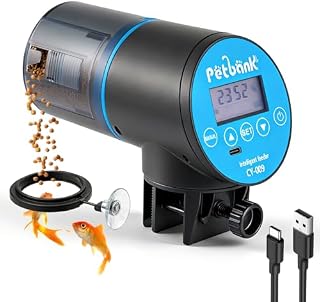
Automatic Fish Feeder for Aquarium Easy Setup & 4 Timers Blue | 200ML Rechargeable Auto Food Dispenser for Flakes & Pellets, LCD Display, Vacation Feeding for Small Tank Betta Koi Turtle
Weight
0.29kg
Automatic Feeders · 200-500 g · 19 products
Weight is 0% against the class median of 0.29.

Automatic Fish Feeder for Aquarium Easy Setup & 12/24/48H Interval | 200ML USB-C Rechargeable Auto Food Dispenser for Flakes & Pellets, Vacation Feeding for Small Tank Betta Koi Turtle
Weight
0.29kg
Automatic Feeders · 200-500 g · 19 products
Weight is 0% against the class median of 0.29.

AquaMiracle Programmable Automatic Fish Feeder for Aquarium, Auto Fish Food Dispenser with Timer, Volume Adjustable Vacation Aquarium Feeder with Digital Display, for Granules Pallets Strips
Weight
0.28kg
Automatic Feeders · 200-500 g · 19 products
Weight is -3% against the class median of 0.29.
Portion consistency is the specification nobody publishes
Seven listings in this class state a tank rating and none state a portion size or a tolerance, which is the figure that decides whether a feeder is useful. The mechanism matters more than the marketing: an auger dispenses a fairly consistent volume, while a rotating drum with compartments delivers whatever was loaded into each one. Neither is stated in comparable terms anywhere here, which is why this page describes the mechanisms rather than ranking the products.
Humidity is what actually breaks them
A feeder sits above a warm body of water, and food that absorbs moisture clumps, bridges and stops dispensing — usually a few days into the week nobody is home. Units with a sealed hopper, a desiccant compartment or a fan that blows dry air across the outlet are addressing the real failure mode. Flake is the worst offender and pellets are considerably more tolerant, so the choice of food matters as much as the choice of feeder.
Underfeed deliberately
The failure that kills a tank is overfeeding, not underfeeding: uneaten food decays, ammonia rises and the biological filter is overwhelmed, while a fish that eats a little less for a week is simply a fish that eats a little less. Setting a feeder to less than a hand-fed portion is the correct instinct, and testing it for a week while at home is the only way to discover what the mechanism actually delivers before relying on it.
What a feeder does not replace
An automatic feeder covers feeding and nothing else. It does not top off evaporation, notice a heater failure, spot a fish in distress or clear a blocked filter. For a week away it is one part of a set that usually also includes an auto top-off and someone willing to look at the tank once. Treating a feeder as the whole solution for a long absence is the mistake this class quietly encourages.
Mounting, and the gap between hopper and water
A feeder sits on the rim or on the glass lid, and where it sits decides how much moist air reaches the food. A unit mounted directly over an open tank is in the worst position; one set back from the water with a lid between them is in the best. Some feeders have an adjustable arm for exactly this reason. It is the cheapest improvement available in this class and it is rarely mentioned in a listing.
Common questions
How long can fish go without food?
Longer than most owners assume for healthy adult fish, and it varies by species, age and stocking. Ask a livestock-aware source about your specific tank rather than treating a feeder as mandatory for a short trip.
Why is there no comparison page here?
Because only weight and a fragile capacity figure clear our gates, and neither predicts the things that decide a feeder — jamming, clumping and portion repeatability.
Will a feeder work with flake food?
Some do and many struggle, because flake bridges in a dispenser where pellets flow. Check the product’s own documentation for the food type you actually use.
Do you recommend a specific feeder?
No. Test whichever you buy over several days while you are still there to watch it.